Where to Add a Poll to Your Website
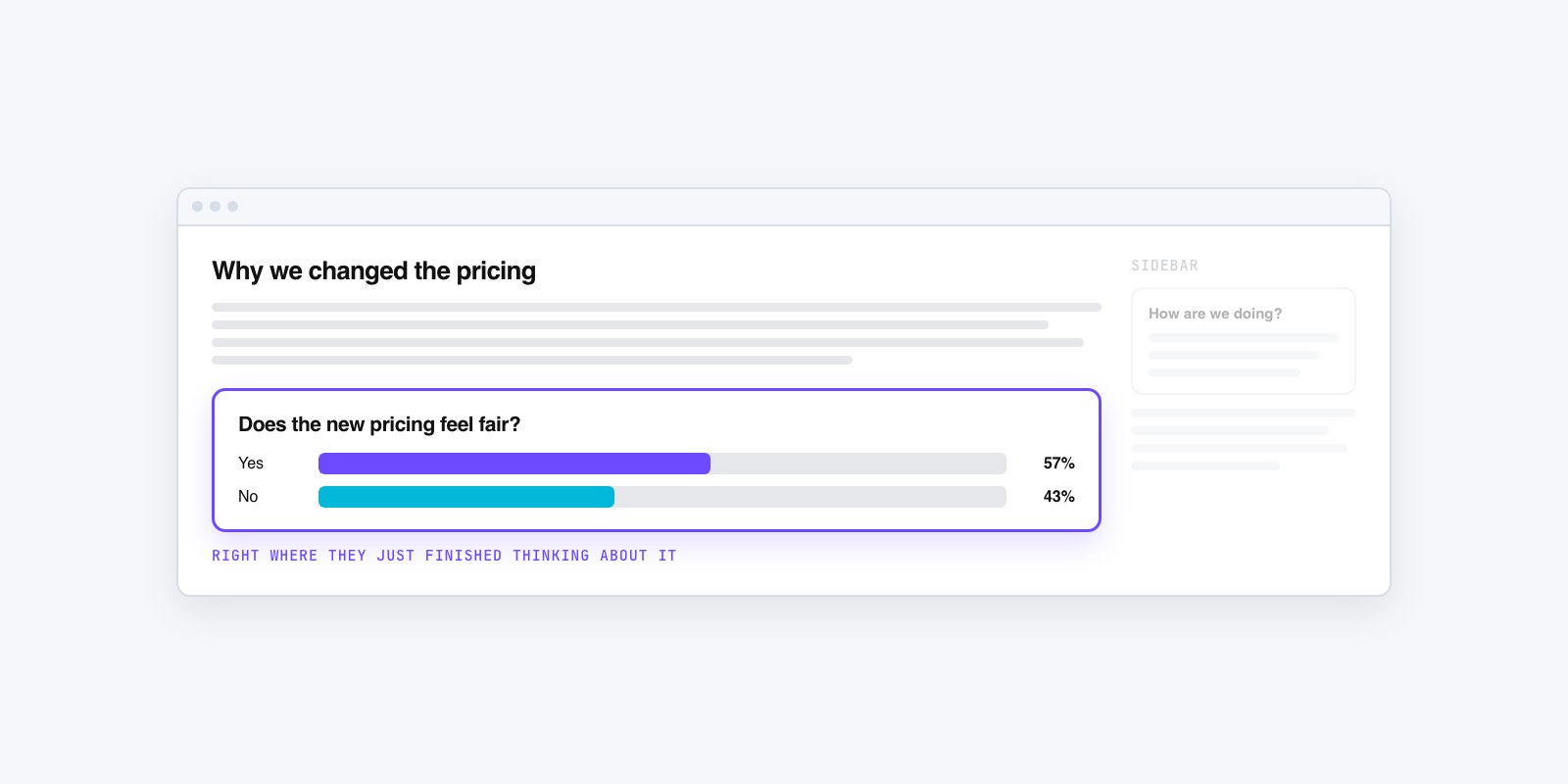
A well-built poll can still collect eight votes in a month, and the question is rarely the reason. The placement is. Where a poll sits on the page decides how many people are still in the right frame of mind to answer it, and most polls die in a spot where nobody is thinking about the thing they’re being asked. The rule underneath all of this is simple: put the poll where the reader just finished thinking about that exact question. Prominence loses to context almost every time.
The end of a relevant article is the best seat in the house
If you only ever use one spot, use this one. A reader who just finished a post about whether to switch to a standing desk has the topic loaded in their head, an opinion half-formed, and a little momentum to spend. A poll sitting right below that last paragraph catches all of it. “After reading this, are you switching to a standing desk?” lands because the reader was already answering it in their mind.
The trick is relevance, not just position. The poll has to match what the article was actually about. A recipe blogger can close a post comparing gas and induction cooktops with “Which would you put in your next kitchen?” and watch it fill up, because the reader just spent five minutes weighing exactly that. Drop a generic “How do you like our site?” in the same spot and it dies, because it has nothing to do with what just happened in the reader’s head. End-of-article works because of what came before it, not because the bottom of a post is magic. Getting it down there is a small job on most platforms, a block or shortcode on a WordPress site and an embed snippet nearly everywhere else.
Inline, when the poll is part of the argument
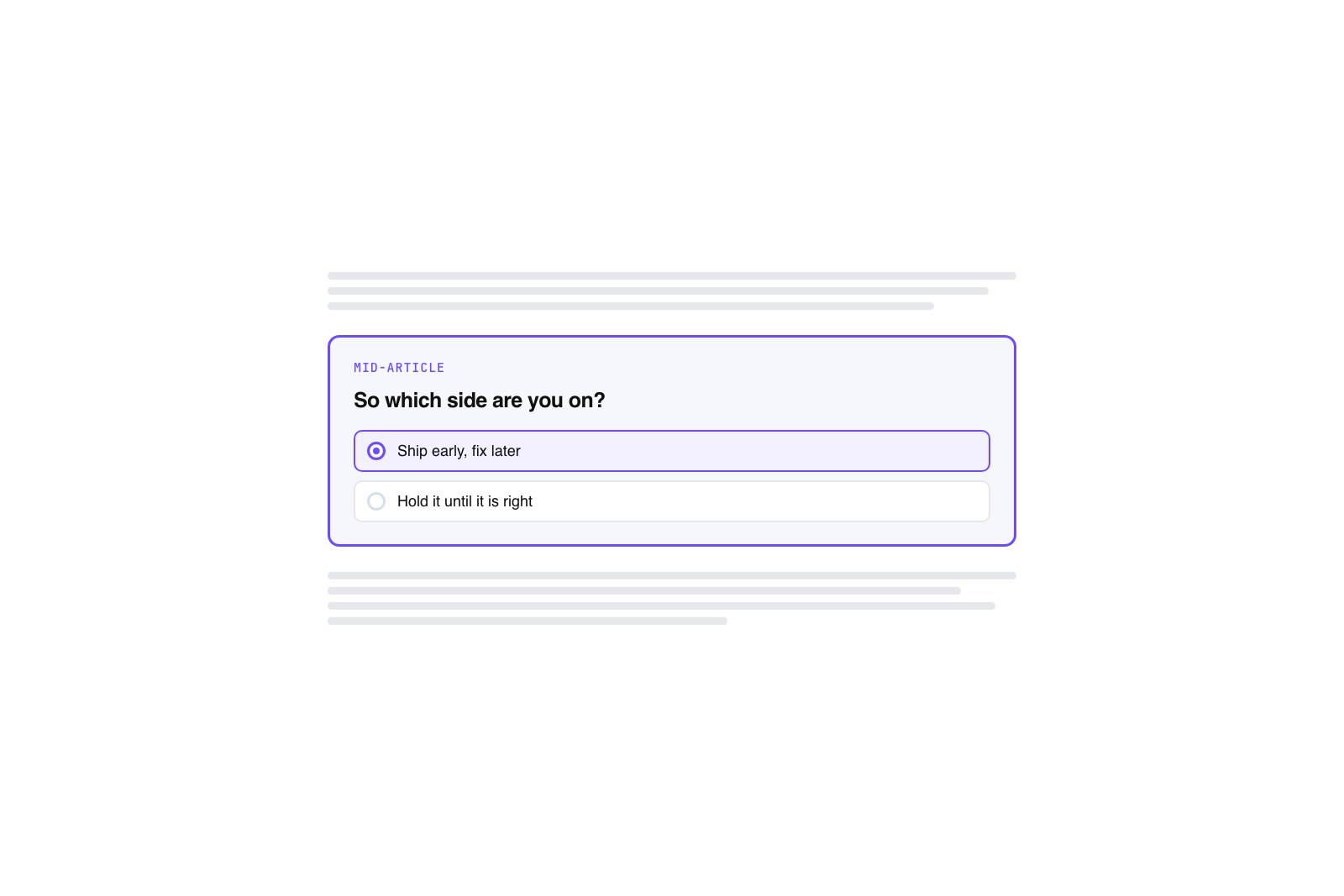
Sometimes the poll shouldn’t wait for the end. If a post builds toward a genuine either/or, dropping the poll at that exact fork can beat saving it for the bottom. A post walking through two budgeting methods can pause right after laying both out and ask “Which one are you leaning toward?” The reader has just heard both sides and hasn’t yet been told what to think. That’s the peak moment of opinion, and an inline poll captures it while it’s hot.
Use this carefully, because an inline poll interrupts reading. It only earns its place when the question is genuinely on the reader’s mind at that spot. Bury it mid-section in an unrelated stretch and you’ve put a speed bump in your own article. When it fits, though, it can outperform the end-of-post poll, because you’re catching the opinion at the moment it forms instead of after the reader has mentally moved on. You can build one on GFX Poll Studio and paste it in wherever the argument reaches its fork; the mechanics of dropping it in cleanly are the same on any platform.
The sidebar is where polls go to quietly disappear
The sidebar feels like the obvious home for a poll. It’s a widget slot, it’s always visible, it’s out of the way. That’s exactly the problem. “Always visible” on modern sites means trained to be ignored. Readers learned years ago that the sidebar holds ads, newsletter boxes, and “popular posts” widgets, so their eyes skip it on the way to the content. A poll parked there inherits all of that banner blindness.
There’s a deeper issue too. A sidebar poll has no context. It sits next to whatever article the reader happens to be on, so it can’t ask anything tied to what they’re currently reading. It’s stuck asking something generic, and generic questions collect generic non-answers. If you must run a persistent poll in a fixed spot, at least make it a genuinely site-wide question (more on that below) and give it enough visual weight to read as content instead of decoration. How a poll looks changes whether people treat it as answerable at all, which is worth a pass through the design habits that make a poll feel worth clicking.
The homepage earns a poll only for a site-wide question
A homepage poll is the right call in exactly one situation: when the question is about the whole site or the whole audience, not any single piece of content. A community hub asking “What should we cover more of this year?” belongs on the homepage, because every visitor is qualified to answer it and the answer shapes the whole site. A nonprofit newsletter landing page asking “Which cause should our next campaign focus on?” fits for the same reason. That’s a legitimate use of the most-trafficked page you have.
Almost everything else is a mistake there. The homepage is where new visitors are still deciding whether to stick around, and it has no specific topic loaded in anyone’s head yet. A narrow poll like “Rate our new checkout flow,” aimed at people who haven’t done anything on the site yet, gets ignored or answered badly. Save the homepage for the one big question that genuinely belongs to the entire audience, and route every topic-specific poll to the pages where that topic actually comes up. A SaaS changelog poll about a new feature belongs beside the feature, not on the front door.
Exit and interstitial polls: strong, easy to overuse
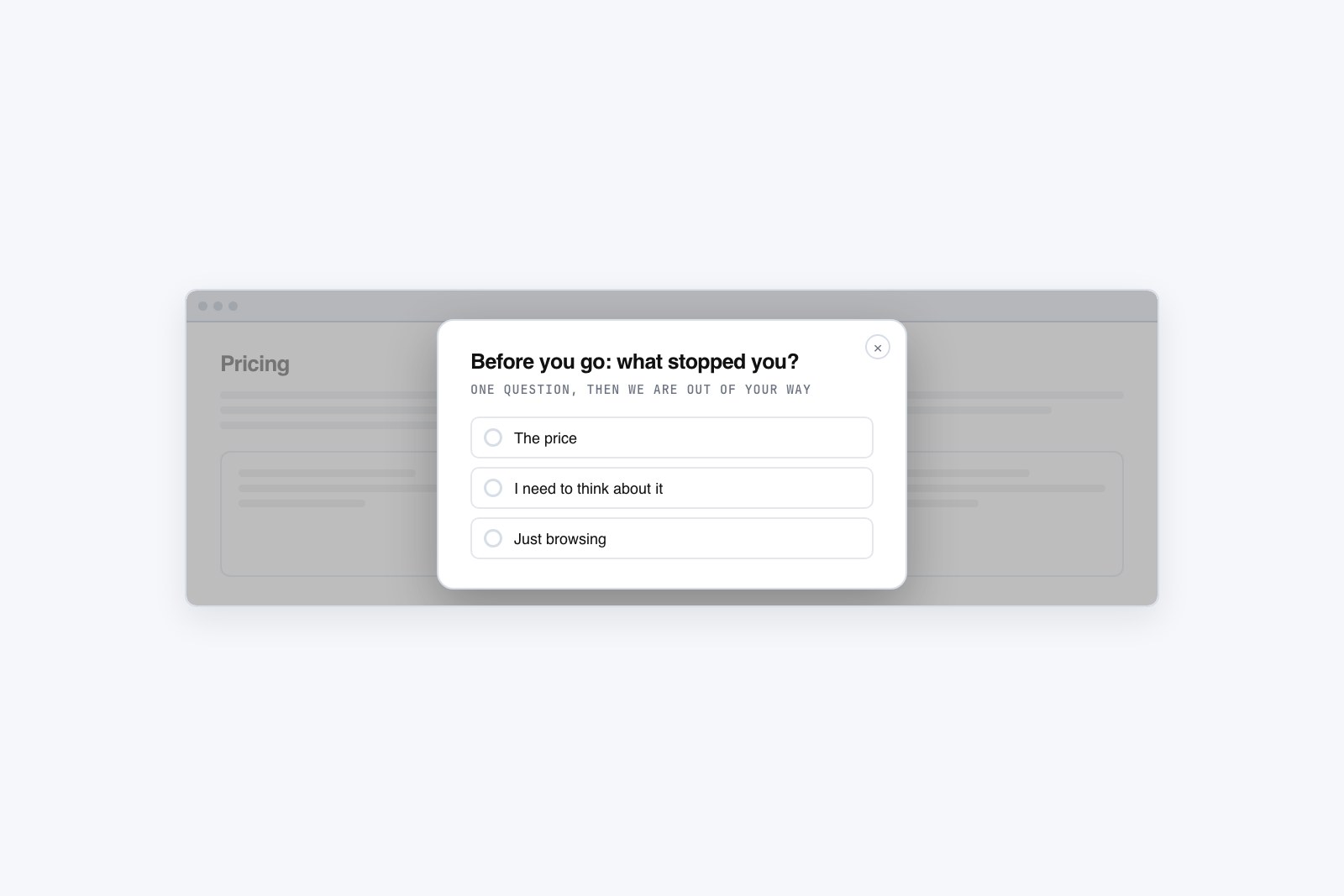
The last placement is the loud one. An exit-intent poll that appears as a reader moves to leave, or an interstitial that fires between pages, can pull real answers precisely because it’s hard to ignore. A single well-timed exit poll like “What were you hoping to find today?” on a page with a high bounce rate can surface things no in-page poll would, because it catches people at the moment they’re giving up.
That power is exactly why it’s easy to abuse. Every interruption spends a little of the reader’s patience, and a popup poll spends a lot of it. Fire one on every visit, or stack it on top of a newsletter popup and a cookie banner, and you’ve turned a useful question into one more thing to dismiss. Use interruption rarely, on the pages where a normal poll can’t reach, and only with a question worth the intrusion. The channel changes the math here as well. A poll pinned inside a forum thread plays by different rules than one on a static page, because that audience showed up to discuss in the first place, so the “interruption” is what they came for. Interrupt only when you’ve earned the right. The rest of the time, let context do the work and put the poll where the reader is already thinking about the answer.